Lead Generation and CRM for Small Business Australia
Sales and client tools to help you attract leads, manage enquiries, follow up with potential clients and create a smoother client experience.
If you are looking for lead generation and CRM for small business Australia, you are probably ready for a better way to manage your sales process.
Maybe you are getting enquiries, but they are spread across your inbox, DMs, website forms, referrals, networking conversations and social media.
Maybe people are asking questions, booking calls or showing interest, but you do not have one clear place to track who is warm, who needs follow-up and who is ready to take the next step.
Or maybe you know your business needs more leads, but you also know that getting more leads will not help if you do not have a system to manage them properly.
That is where the right lead generation and CRM tools become incredibly valuable.
A strong sales and client system helps you attract potential clients, capture their details, track conversations, follow up consistently, book calls, send payment links, onboard clients and create a more professional experience from first enquiry through to delivery.
You do not need a complicated tech stack to grow your business.
You need the right tools in the right places.
The right lead generation and CRM tools can help small business owners:
Capture new leads
Track enquiries
Manage conversations
Follow up with potential clients
Book calls and appointments
Send payment links
Create enquiry and intake forms
Improve client onboarding
Keep client details in one place
Reduce manual admin
Stop leads from slipping through the cracks
This page brings together practical tools for Australian small business owners, service providers, virtual assistants, coaches, consultants and growing businesses who want their sales and client journey to feel clearer, calmer and more organised.
Why Lead Generation And CRM Matter For Small Business Owners
Lead generation gets potential clients into your world.
Your CRM helps you manage what happens next.
A lot of small business owners focus heavily on visibility and marketing, but forget about the backend system that supports the sale.
They work hard to create content, network, get referrals, run ads, post on social media or drive people to their website.
Then the lead comes in and the process becomes messy.
The enquiry sits in an inbox.
The follow-up gets forgotten.
The call notes live in a notebook.
The proposal gets sent, but nobody follows up.
The client says “not right now,” and then disappears forever because there was no nurture process.
This is why lead generation and CRM need to work together.
More leads are not always the answer.
Sometimes the bigger opportunity is managing the leads you already have more effectively.
A lead generation system helps you attract and capture potential clients.
A CRM helps you track, nurture and convert those leads.
Together, they give your business a clearer path from visibility to enquiry to conversation to client.
The Problem With Managing Leads Manually
Most small business owners start by managing leads manually.
At first, this feels fine.
You know who has messaged you.
You remember who asked about your services.
You know who needs a reply.
You can keep track of a few conversations in your head.
But as your business grows, leads can come from multiple places:
Website forms
Instagram DMs
Facebook messages
Email enquiries
LinkedIn conversations
Referral partners
Networking events
Free resources
Webinars
Discovery calls
Paid ads
Google searches
Word of mouth
Without a clear system, these conversations become scattered.
That is when opportunities start slipping through the cracks.
Not because you do not care.
Not because the lead was not interested.
But because the business has outgrown the way you were managing enquiries.
This is usually the point where small business owners need better lead generation and CRM tools.
The goal is not to make your business feel more complicated.
The goal is to give your business a simple system that helps you see what is happening, what needs attention and what step comes next.
What To Look For In Lead Generation And CRM Tools
When choosing lead generation and CRM for small business Australia, the goal is not to find the fanciest platform.
The goal is to choose tools that support the way your business actually sells.
But as your business grows, leads can come from multiple places:
Website forms
Instagram DMs
Facebook messages
Email enquiries
LinkedIn conversations
Referral partners
Networking events
Free resources
Webinars
Discovery calls
The right tools should support both sides of the process:
Lead generation — attracting and capturing potential clients.
CRM and client management — tracking, nurturing and converting those leads.
If your tools only help you get leads but do not help you manage them, your business can still feel chaotic.
If your CRM stores contacts but does not support follow-up, bookings or client onboarding, you may still be doing too much manually.
The best setup is one where your lead generation and CRM tools work together.
CRM & Lead Management Tools
These tools help you capture leads, manage enquiries, track conversations and create a clearer sales process.
This is the foundation of a strong sales and client system.
Totally Unleashed / HighLevel CRM
Totally Unleashed CRM, powered by HighLevel, is a CRM and automation platform designed to help small business owners manage leads, pipelines, forms, funnels, bookings, automations and client communication in one place.
Instead of using separate tools for landing pages, enquiry forms, email follow-up, appointment bookings and sales pipelines, a HighLevel-based CRM setup can bring the key parts of your sales process together.
This can be especially useful for service-based businesses that rely on enquiries, applications, calls, consultations, bookings, quotes or follow-up conversations.
Why small business owners use it:
A CRM like HighLevel helps small business owners stop managing leads manually and start tracking opportunities properly.
It gives you one place to see who has enquired, what stage they are at, what needs to happen next and which leads need follow-up.
For many small businesses, the issue is not always a lack of leads.
It is a lack of structure around the leads already coming in.
A CRM helps fix that.
FlowChat
FlowChat is a tool that can support social selling, outreach, warm lead conversations and follow-up tracking.
For businesses that generate leads through social media conversations, Facebook groups, LinkedIn, DMs, networking or relationship-based outreach, FlowChat can help you keep track of conversations and next steps.
This is especially helpful when your sales process is not just “someone fills in a form.”
Sometimes leads come from real conversations.
FlowChat can help you manage those conversations more intentionally.
Best for:
Social selling
DM outreach
Warm lead tracking
Relationship-based sales
Facebook lead activity
LinkedIn lead activity
Follow-up conversations
Why small business owners use it:
A lot of sales start in conversation.
FlowChat can help make those conversations easier to manage so warm leads do not get lost in your inbox or forgotten after the first interaction.
Lead Capture & Form Tools
Lead generation starts when someone raises their hand.
That might be through a website enquiry, free resource, webinar registration, quote request, application form or contact form.
If your lead capture process is clunky, people may not take the next step.
If your lead capture process is disconnected from your CRM, you may end up manually copying information from one place to another.
The right lead capture tools help potential clients enter your world and help you store their information properly.
CRM Forms
CRM forms can be used to collect lead information and send it directly into your sales system.
This means when someone fills in an enquiry form, application form or booking form, their details can be added to your CRM automatically.
You can use forms for:
General enquiries
Service enquiries
Free resources
Webinar registrations
Discovery call applications
Quote requests
Client intake forms
Feedback forms
Testimonial requests
Best for:
Lead capture
Enquiry forms
Application forms
Client onboarding
Intake forms
Free resource delivery
Service-based businesses
Why small business owners use them:
Forms help you collect the right information upfront.
When connected to your CRM, they also reduce manual admin because the lead details are stored in the right place from the beginning.
This helps your lead generation and CRM system work together instead of creating more scattered admin.
Funnels & Landing Pages
Funnels and landing pages help you guide people toward a specific action.
That could be joining a free training, downloading a resource, booking a call, submitting an enquiry or applying for a program.
Unlike a general website page, a landing page is usually focused on one clear next step.
For small business owners, landing pages can be useful when you want to create a simple lead generation pathway.
Best for:
Free resources
Webinar registrations
Discovery call bookings
Program applications
Service enquiries
Paid ads
Lead generation campaigns
Why small business owners use them:
Landing pages help create a focused path for potential clients.
Instead of sending people to a general website and hoping they know what to do, you can send them to a page designed around one action.
When connected to your CRM, landing pages can become part of a much stronger lead generation and follow-up system.
Booking & Call Tools
Once someone becomes interested, the next step is often a call, consultation, quote or appointment.
Your booking process matters because it shapes the client experience before someone has even paid you.
If booking a call feels clunky, confusing or manual, it creates friction.
The right booking and call tools help potential clients take the next step easily.
Google Meet
Google Meet is a simple video meeting tool that can be used for discovery calls, client sessions, sales calls, onboarding calls, team meetings
and online consultations.
It is easy to access and works well for small business owners who need a reliable way to meet with leads or clients online.
Best for:
Sales calls
Discovery calls
Client meetings
Online consultations
Onboarding calls
Team meetings
Virtual service delivery
Why small business owners use it:
Google Meet is simple, familiar and easy to connect with calendar invites.
For service-based businesses, it gives you a professional way to meet with leads and clients without needing complicated software.
CRM Booking Calendar
If you are using a CRM like HighLevel, having a booking calendar connected to your lead pipeline can make your sales process much smoother.
Instead of using a separate booking tool that is disconnected from your CRM, your calendar can connect directly to your pipeline, automations and contact records.
That means when someone books a call, they can automatically be added to the right stage, receive confirmation emails and trigger reminders.
Best for:
Discovery calls
Strategy sessions
Consultations
Quote calls
Application calls
Automated reminders
Connected sales pipelines
Why small business owners use it:
A connected booking calendar reduces manual admin and makes your sales process feel more professional.
It can also help reduce no-shows by sending reminders before the call.
When your calendar is connected to your CRM, your booking process becomes part of your sales system instead of sitting separately from it.
Payment & Client Setup Tools
Once someone says yes, your systems need to support the next step.
Payment and onboarding tools help turn a verbal yes into a smoother client experience.
This part of the journey matters because a messy onboarding process can make a new client feel unsure.
A clear process builds trust.
It also saves you from manually recreating the same emails, links and instructions every time someone becomes a client.
Stripe
Stripe is an online payment platform that allows small business owners to accept card payments, create payment links,
manage subscriptions and take online payments securely.
It is useful for service providers, coaches, consultants, online businesses and anyone who needs a simple way to receive payments online.
Best for:
Payment links
Online payments
Subscriptions
Payment plans
Client invoices
Digital offers
Service-based businesses
Why small business owners use it:
Stripe makes it easier to collect payments professionally.
Instead of manually sending bank details or chasing payment, you can create clear payment links and connect payments into your sales or onboarding process.
For small businesses, this can make the transition from lead to paid client feel much smoother.
Client Intake Forms
Client intake forms help you collect the information you need after someone becomes a client.
They can also be used earlier in the sales process for applications, discovery calls or quote requests.
An intake form might collect:
Contact details
Business details
Goals
Challenges
Service requirements
Login requirements
Project details
Preferences
Important dates
Background information
Best for:
Client onboarding
Discovery call preparation
Application calls
Project scoping
Service enquiries
Coaching or consulting clients
Why small business owners use them:
Client intake forms save time and help you collect important information upfront.
When connected to your CRM, they also keep client information organised in one place.
This creates a smoother handover from sales to delivery.
Client Communication Tools
Good communication builds trust.
From the first enquiry through to onboarding and delivery, your leads and clients need to know what is happening,
what to expect and what the next step is.
The right communication tools help you stay clear, consistent and professional.
Email Automation
Email automation allows you to send the right message at the right time without writing everything manually.
This can be used for:
New enquiry confirmations
Free resource delivery
Call booking confirmations
Call reminders
Post-call follow-up
Proposal follow-up
Client onboarding
Nurture sequences
Reactivation campaigns
Email automation is not about removing genuine connection.
It is about making sure important communication actually happens.
Best for:
Lead nurture
Follow-up
Free resource delivery
Sales sequences
Client onboarding
Re-engagement campaigns
Small business communication
Why small business owners use it:
Email automation helps you stay consistent even when you are busy.
It means leads are not left waiting and clients receive the information they need without you manually sending the same email over and over.
This is one of the biggest benefits of connecting your lead generation and CRM tools properly.
SMS Reminders
SMS reminders can be useful for businesses that book calls, appointments, consultations or services.
They can help reduce no-shows, remind leads about upcoming calls and make the booking experience feel more professional.
Best for:
Appointment reminders
Call reminders
Missed call follow-up
Local service businesses
Consultation-based businesses
Time-sensitive communication
Why small business owners use it:
People miss emails.
SMS can be a helpful way to send short, timely reminders when someone has booked a call or appointment.
When used well, SMS reminders can improve the client experience without feeling overwhelming.
Proposal & Follow-Up Tools
Not every lead buys immediately.
Some people need more information.
Some need time.
Some need a proposal.
Some need a reminder.
Some need to be nurtured until the timing is right.
This is why follow-up tools are so important.
Sales Pipelines
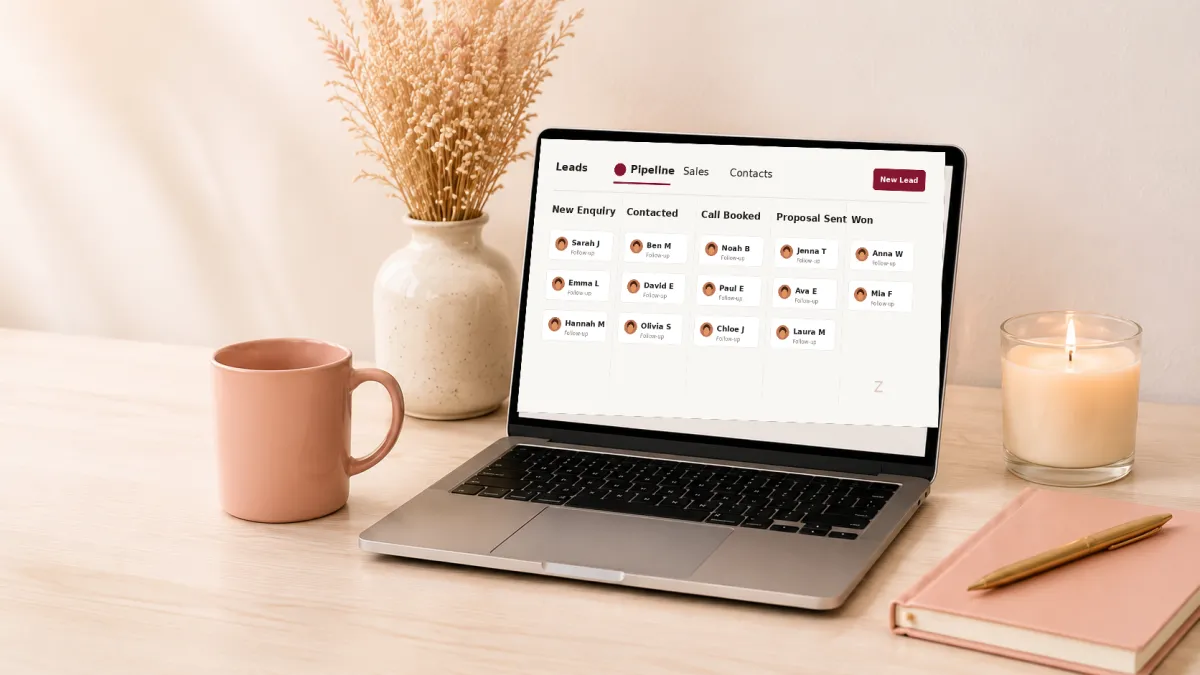
A sales pipeline gives you a clear view of every lead and where they are in the sales process.
Your pipeline might include stages like:
New enquiry
Contacted
Call booked
Call completed
Proposal sent
Follow-up required
Won
Lost
Nurture
This helps you stop relying on memory.
Best for:
Lead tracking
Sales visibility
Follow-up management
Proposal tracking
Conversion improvement
Small business sales systems
Why small business owners use it:
A sales pipeline helps you see what is happening in your business.
You can quickly identify who needs attention, where opportunities are sitting and what needs to happen next.
For small business owners, this visibility can make sales feel much less overwhelming.
Follow-Up Reminders
Follow-up reminders help make sure leads do not disappear after the first conversation.
A reminder could be triggered after a call, after a proposal is sent or when someone asks you to check back later.
Best for:
Warm leads
Proposal follow-up
Sales calls
Long-term nurture
Relationship-based sales
Service-based businesses
Why small business owners use it:
Many sales happen after the first conversation.
Follow-up reminders help you stay professionally present without needing to remember everything yourself.
This is one of the simplest ways to stop good opportunities from being lost.
Choosing The Right Lead Generation And CRM Tools
The right tools depend on the problem you are trying to solve.
You do not need every tool on this page at once.
Start by looking at where your business currently feels messy.
Ask yourself:
Where are my leads coming from?
How do I currently track enquiries?
Am I following up consistently?
Do I know which leads are warm?
Do I have a clear booking process?
Are my forms connected to my CRM?
Is onboarding smooth?
Am I manually repeating the same steps?
Are potential clients slipping through the cracks?
Do I know my sales numbers?
Do I have a clear client journey?
If your biggest issue is lost leads, start with a CRM.
If your biggest issue is not enough enquiries, look at your lead generation pathways.
If your biggest issue is messy conversations, improve your lead tracking.
If your biggest issue is no-shows, improve your booking and reminder process.
If your biggest issue is clunky onboarding, build client forms and automated welcome steps.
The right tools should solve the problem in front of you.
Simple Lead Generation And CRM Stack For Small Business Owners
If you are just starting to build your sales and client system, keep it simple.
A strong starter stack might include:
A CRM to track leads and clients
A lead capture form for enquiries
A booking calendar for calls or appointments
Email follow-up for communication
Stripe for payments
Google Meet for calls
A simple pipeline to track sales stages
This gives you the core foundations to manage sales and clients more professionally.
You can add more advanced automations later.
Growth-Stage Lead Generation And CRM Stack
If your business is already getting consistent enquiries, you may need a more connected system.
That might include:
CRM pipelines
Automated lead capture
Lead generation funnels
Call booking workflows
SMS reminders
Proposal follow-up
Nurture sequences
Client onboarding workflows
Payment links
Sales reporting
Reactivation campaigns
This is where a CRM like HighLevel becomes more useful because it can connect multiple parts of the journey in one place.
For many small business owners, this is the difference between having tools and having an actual system.
Lead Generation And CRM For Small Business Australia: What Matters Most
When people search for lead generation and CRM for small business Australia, they are usually looking for a way to make sales feel more organised and consistent.
They may need more enquiries.
They may need a better follow-up process.
They may need a CRM that shows where every lead is sitting.
They may need a booking system, forms, automations or better client onboarding.
The right setup should help you:
Attract potential clients
Capture lead details
Track conversations
Follow up consistently
Book calls and appointments
Take payments
Onboard clients smoothly
Reduce manual admin
Improve your client experience
Understand your sales process
Your sales system should not live in your head.
Your leads should not be scattered across inboxes, DMs and spreadsheets.
With the right lead generation and CRM tools, your business can become much easier to manage.
Build A Better Sales And Client System
Sales do not need to feel scattered.
Client onboarding does not need to feel clunky.
Follow-up does not need to rely on memory.
With the right tools, you can create a sales and client system that helps you attract leads, track conversations,
follow up professionally and support people from first enquiry through to client.
Whether you are looking for lead generation and CRM for small business Australia, a better booking process,
stronger follow-up tools or a smoother client onboarding experience, the goal is the same:
A business that feels clearer, calmer and easier to run.
Choose the tools that solve the problem in front of you right now.
Then build from there.
Ready To Create A Better Sales And Client System?
Join our free community of women building businesses with freedom, flexibility and purpose.
Inside, you’ll find:
Inside, you’ll find:
Free resources and training
Business tools and recommendations
Support from women who get it
Practical conversations about sales, systems and growth
Guidance to help you simplify your next step
If you are building a business and want support, tools and clarity along the way, we would love to have you inside the community.
Affiliate Disclosure
Some links on this page may be affiliate links, which means we may earn a commission if you choose to purchase through them.
We only recommend tools we genuinely use, trust or believe will support your business growth.
We’re here to help you build a business that supports your life and your freedom.